سخن سردبیر
عنوان مقاله English
نویسنده English
Preface: Museum Studies as an Interdisciplinary Field of Knowledge
In the contemporary era, the field of museum studies and cultural heritage conservation has moved beyond the mere collection and physical description of objects and has evolved into a dynamic, research-oriented, and inherently interdisciplinary field. Today, museums and museum objects are no longer regarded merely as places or repositories for preserving and displaying remnants of the past. Rather, they constitute living material records that provide a basis for reexamining the political, identity-related, technological, aesthetic, and sociological dimensions of past societies. In this issue, the specialized biannual journal Zarrīn Fām Museum Studies seeks to open new perspectives on the less explored and underdocumented dimensions of Iran’s tangible and intangible heritage by bringing together twelve original scholarly articles by researchers from across the country.
This issue covers a broad range of specialized fields, including the symbolism of luxury arts, Islamic architecture and the redesign of decorative elements, codicology and laboratory analysis of manuscript artifacts, landscape archaeology, historical roads and rock-cut architecture, and, finally, the application of emerging technologies and the natural sciences to museum conservation and restoration. The following sections introduce the principal scholarly contributions presented in this issue.
Theme One: Symbolism and the Representation of Power in Luxury Arts and Crafts
Historical luxury textiles and metalwork have consistently functioned, beyond their utilitarian purposes, as powerful media for representing political authority, religious legitimacy, and cultural identity. In the first study within this theme, Sahar Abdolahi examines the iconography and symbolism of an Abbasid-period silk tiraz preserved at the Tar-o-Pood Museum in Yazd. Tiraz textiles, which were inscribed fabrics woven in royal workshops and bestowed as robes of honor during official ceremonies, played a key role in the administrative and ideological system of the caliphate. Drawing on Erwin Panofsky’s three-stage model and conducting a comparative analysis with a similar example preserved at the Cleveland Museum of Art in the United States, the author demonstrates that this textile, through the combination of the Kufic inscription “Ahmad ibn al-Hasan al-Nasir” with animal and vegetal motifs, including a lion, camel, archer, and cypress tree, reflects the continuity of Sasanian artistic traditions and their reinterpretation within the political thought of the Abbasid period. Within this coherent composition, the lion represents royal power, the camel signifies territory and economic resources, the archer symbolizes rationality and human agency, and the cypress represents sacred immortality and religious legitimacy. Together, these motifs encode a cosmological and political order.
Subsequently, Mohammad Ali Haddadian, in an article addressing the formal structures and motifs of gold filigree, examines this distinctive Iranian art and craft from the advent of Islam through the Safavid and Qajar periods. Filigree work, based on the ordered arrangement and refined craftsmanship of fine gold and silver wires, continued under the influence of Sasanian artistic traditions during the early centuries of the Islamic period and reached a high point of development during the Safavid era. Drawing on Gestalt perceptual theory and analyzing components such as form, symmetry, balance, and rhythm in vegetal, geometric, and animal motifs, the researcher proposes a practical and innovative model for reproducing a contemporary jewelry set that retains its cultural and identity-based authenticity while responding to present-day requirements.
In the field of archaeology and numismatics, Amir Mansouri examines Sasanian coins discovered at the Barz-qawela Site in Seymareh–Kuhdasht, Lorestan. As among the most reliable categories of material evidence for reconstructing history, these coins shed light on previously obscure aspects of the political and economic transformations of the late Sasanian period, particularly during the reign of Khosrow II and the rule of Farrukhzad, while also providing valuable evidence concerning the administrative geography and minting practices of western Iran.
Theme Two: Islamic Architecture, Decorative Elements, and Reconsideration of Architectural Transformations
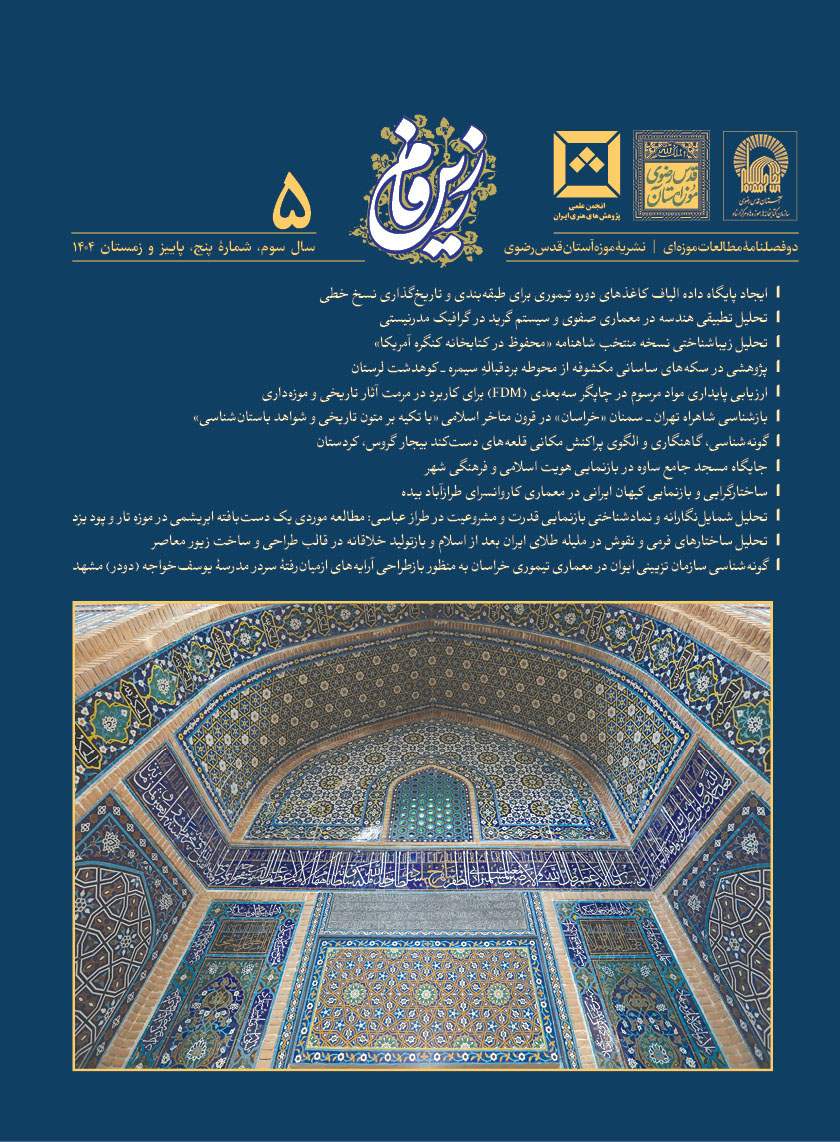
Historical and religious monuments constitute the living physical and identity-based records of Islamic cities, and their structural and conservation assessment requires rigorous scientific and stylistic approaches. In this context, Mehdi Sahragard, in an applied study, examines the typology of the decorative organization of the ivan in Timurid architecture of Khorasan in order to establish a scholarly basis for redesigning the lost decorative elements of the entrance portal of the Yusuf-Khwaja (Do Dar) Madrasa/School in Mashhad. The portal of this monument, dating to the reign of Shah Rukh of the Timurid dynasty (843 AH), lacked direct visual documentation due to extensive damage. Through a comparative analysis of contemporary monuments, including the Balasar School, the Goharshad Mosque, and the Mausoleum of Abu Bakr Taybadī, together with field investigations that revealed remnants of mosaic tilework beneath later rasmi-bandi additions, the author reconstructs the original structure of the ivan. A major contribution of this article is the proposed methodology for distinguishing between “documented reconstruction,” based on material and written evidence, and “new design,” developed within the framework of stylistic principles. This approach is consistent with international conservation charters, including the Venice Charter.
In another area of religious architecture, Melika Keyvani-Nejad examines the position of the Jameh Mosque of Saveh in representing the Islamic and cultural identity of the city. The Jameh Mosque of Saveh was not an isolated monument but rather constituted the central nucleus of the city’s spatial organization in conjunction with the bazaar and caravanserai. The author explains the approximately 800-year architectural development of the monument through four key phases: (1) the initial hypostyle core dating to the second century AH, comparable to the Tarikhaneh Mosque of Damghan; (2) the Seljuk transformation, including the construction of the domed chamber and a brick minaret dated to 504 AH; (3) the construction of the elevated western ivan during the Ilkhanid period; and (4) the reconstruction of the domed chamber in a cruciform plan and the addition of elaborate tilework during the Safavid period.
Furthermore, Abdolmahdi Hemmatpour and Zeynab Niknafas Gonoui, in a structuralist study, examine the representation of the Iranian cosmos in the architecture of the Tarazabad caravanserai at Bideh. Within the Iranian architectural tradition, caravanserais not only responded to functional and security requirements but also expressed symbolic dichotomies such as light and darkness and periphery and center, as well as a geometric order corresponding to the Iranian conception of the cosmos, through their spatial organization.
Theme Three: Codicology, Book Arts, and Laboratory Sciences in the Study of Manuscripts
Manuscripts, as textual and visual repositories, preserve invaluable evidence concerning the history of art, paper-making technologies, and book arts in the Islamic world. Zahra Pourshabanian, in an article, examines the aesthetic and codicological characteristics of the Selected Shahnameh of Ferdowsi preserved in the Library of Congress. This exquisite 92-folio manuscript, copied in elegant nasta'liq script by Seyyed Ali, son of Seyyed Hashem, in Jumada al-Awwal 1027 AH during the Safavid period, contains a double illuminated frontispiece, three-color ruling, an embossed leather binding, and three valuable paintings. The manuscript painter, drawing on conventions prevalent in royal workshops and employing subtle chiaroscuro effects in the depiction of rocks, horses, and military garments, has rendered scenes from the epic Shahnameh.
Elsewhere, Maryam Mirani, Mohsen Mohammadi Achachloui, Davoud Afhami Sisi, and Nafiseh Yousefi, in an original laboratory-based study, have established a database of paper fibers from the Timurid period for the classification and dating of manuscripts. Given that many manuscripts are undated or contain damaged or unreliable information, identifying the material characteristics of paper constitutes a key tool for codicologists. By conducting microscopic and structural analyses of 50 dated Timurid manuscripts from the repository of the Astan Quds Razavi, the researchers identified the fibers used in the paper pulp and developed a standardized archival database for dating and determining the provenance of manuscripts of unknown identity.
Theme Four: Landscape Archaeology, Roads, and Rock-Cut and Excavated Architecture
Understanding cultural landscapes and historical communication routes provides an analytical framework for examining the economic, military, and regional interactions of past societies.
Vahid Zolfi-Harris, Hassan Hashemi Zarjabad, Abed Taghavi, and Ali Farahani examine the Tehran-Semnan highway, a section of the Great Khorasan Road, during the later Islamic centuries. By integrating historical texts with archaeological evidence, this study explains the role of roadside architecture, including caravanserais, ribats, and watchtowers and defensive towers, in ensuring the security of commercial networks and facilitating interactions between Iran and Central Asia.
In the field of rock-cut architecture, Hamid Amanollahi, Hassan Karimian, and Fatemeh Sheikh-Ahmadi investigate the typology, chronology, and spatial distribution patterns of rock-cut fortresses in the Bijar-Garous region of Kurdistan. These structures, which fall within the categories of rock-based and defensive rock-cut architecture, represent an ingenious combination of constructed stone walls and spaces excavated within the rock, such as cisterns and access tunnels. The findings indicate that these fortresses were initially established during the Sasanian period and were subsequently reconstructed and reinforced during the Seljuk and Ilkhanid periods as defensive strongholds and emergency habitational sites.
Theme Five: Emerging Technologies and the Natural Sciences in Conservation, Restoration, and Sustainable Museum Practice
The scientific conservation of museum objects requires precise assessment of material behavior, adherence to the principles of minimal intervention, reversibility, and distinguishability in conservation treatments. In this context, Mehdi Razani, Jalil Esmaeil-Nejat Teymourabadi, and Sara Hosseinzadegan, in an experimental study, evaluate the durability of conventional materials used in fused deposition modeling (FDM) 3D printing for applications in conservation, restoration, and museum practice. The study addresses the principal question of which of the consumable materials used in these printers exhibit greater durability over time and under environmental conditions. Today, 3D printing technology provides an innovative means of reconstructing missing components, producing replicas, and manufacturing stabilizing supports for unstable museum objects. The researchers selected four commonly used filaments, PLA, ABS, PA, and PETG, and examined changes in their color and structure after exposing printed specimens to ultraviolet radiation. The results indicate that PLA (polylactic acid) exhibited the least color change and, in this respect, is suitable for temporary reconstruction and replica production under museum environmental conditions. PA (polyamide), by contrast, demonstrated better structural stability and was recommended for components requiring structural strength. PETG (polyethylene terephthalate glycol), owing to its relatively limited color change, may be a suitable option in dry environments. ABS (acrylonitrile butadiene styrene) exhibited the greatest changes in color and structure and was not considered suitable for conservation applications. Overall, the article demonstrates that 3D printing can serve as a useful tool for reconstructing missing parts and producing temporary components for museum objects. However, material selection should be undertaken in accordance with environmental conditions and the principles of conservation and restoration.
Concluding Remarks and the Journal’s Outlook
The collection of articles presented in this issue of Zarrīn Fām Museum Studies provides clear evidence of the considerable potential of interdisciplinary research for the analysis, conservation, and interpretation of Iran’s civilizational heritage. The integration of field archaeology, stylistic analysis, laboratory-based codicology, and advanced conservation technologies represents a promising pathway through which museums can be transformed from silent repositories into dynamic centers of knowledge production.
I warmly extend my appreciation to all scholars, researchers, and students who contributed their valuable research findings to the preparation of this issue. I also sincerely thank the esteemed reviewers and members of the editorial board whose rigorous evaluations have enhanced the scholarly quality of the articles. We hope that this issue will constitute an effective step toward advancing the research literature on museum studies and cultural heritage conservation in the country and will facilitate the development of innovative research in the future.
Babak Shaik Baikloo Islam
Deputy Editor-in-Chief, Zarrīn Fām Museum Studies
March 2026