نوع مقاله : مقاله پژوهشی
عنوان مقاله English
نویسنده English
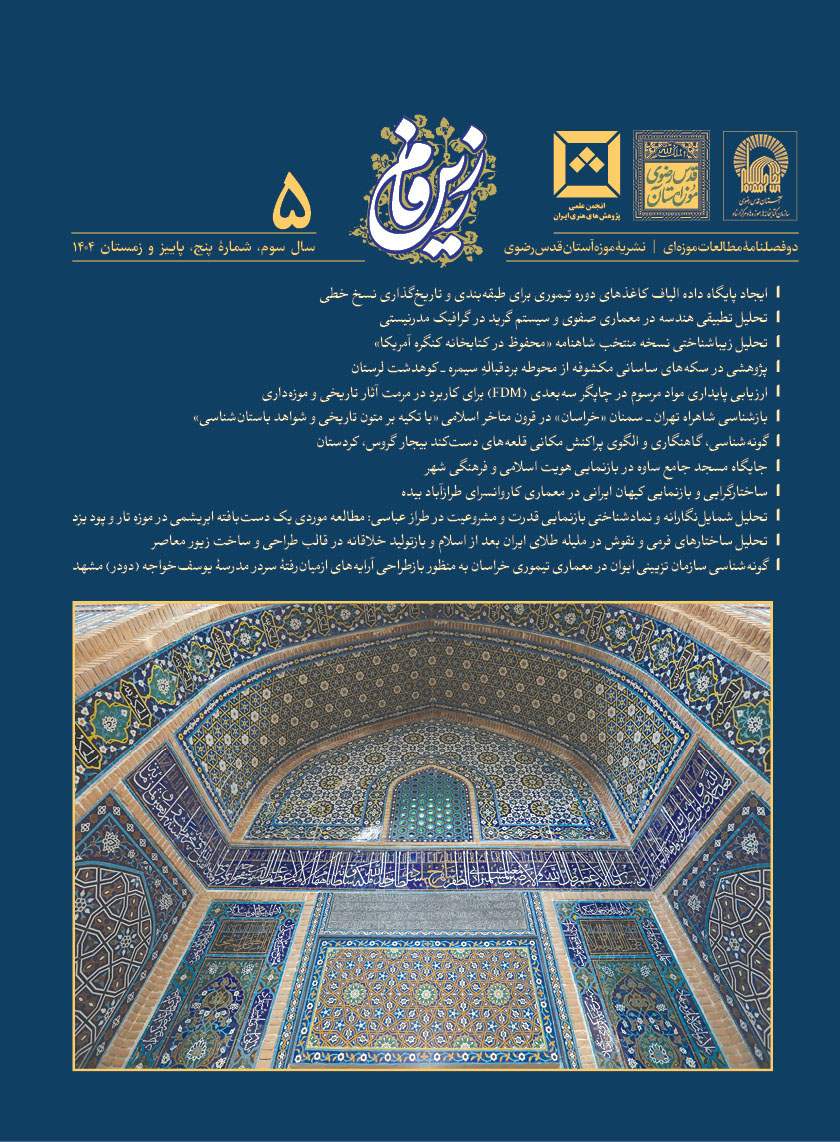
The Yusuf-Khwaja Madrasa, commonly known as Do Dar, located within the Imam Reza Shrine complex, is one of the few surviving Timurid monuments in Mashhad whose portal decoration, despite extensive damage, has retained much of its original structural integrity. The lack of sufficient written or visual documentation concerning the original state of these decorative elements has made their scholarly reconstruction a particularly challenging task. Adopting a comparative stylistic approach, this study first establishes a typology of the decorative organization of Timurid iwans and portal façades in Khorasan and then determines which typological category best corresponds to the portal of the Do Dar Madrasa. Subsequently, by correlating surviving material evidence from the tiles with historical visual documentation and written sources dating to the Qajar period, the study reconstructs the process through which the text of the poetic inscription and the arrangement of the missing tiles on the portal can be recovered. The findings demonstrate that the interior decorative organization of the Do Dar iwan is closely related to the banded type, exemplified by the Mausoleum of Abu Bakr Taybadī, while its façade corresponds more closely to the niche-based type, represented by the Balasar Madrasa and the iwans of the Goharshad Mosque. The study further establishes that the plaster muqarnas beneath the vault is a later addition that is inconsistent with the original Timurid decorative system. Finally, the research demonstrates how such a typological framework can provide a scholarly basis for design and implementation decisions in an actual conservation and restoration project.
1. Introduction
The shrine complex of Imam Reza in Mashhad has historically been surrounded by educational institutions constructed during successive periods, particularly the Timurid, Safavid, and Qajar periods. Among these, only two Timurid madrasas, the Parizad and Yusuf-Khwaja (Do Dar) madrasas, survive in Mashhad. The Do Dar Madrasa, constructed in 843 AH by order of Amir Yusuf-Khwaja Bahadur, is particularly important because its entrance portal preserves the structural organization of its Timurid decorative program more substantially than the surviving examples in the city. In contrast, the portal of the neighboring Parizad Madrasa underwent extensive Safavid-period alteration, while the Balasar Madrasa, another important Timurid monument associated with the complex, was completely demolished during the expansion of the shrine precinct in the Pahlavi period.
The current condition of the Do Dar portal, however, presents serious challenges for conservation and restoration. Extensive deterioration of the façade, loss of large portions of the tilework and inscriptions, and uncertainty concerning the original decorative composition have left significant parts of the portal without direct evidence. These circumstances raise a fundamental methodological problem: when complete written or visual documentation of a historical decorative scheme is unavailable, to what extent can the original appearance be reconstructed without crossing the boundary between scholarly reconstruction and conjectural invention? The conservation principles associated with the Venice Charter emphasize that intervention should stop where conjecture begins and that new additions should remain distinguishable from the historic fabric. This principle is particularly important when reconstructing architectural ornament, where stylistic similarity can easily be mistaken for historical evidence.
Previous scholarship on Timurid architecture has established the importance of regional geometric systems, tilework, and inscriptional conventions, while studies of individual monuments have provided valuable information concerning their architectural structure and decorative programs. Nevertheless, the article identifies a gap in research: the absence of an independent comparative typology of Timurid iwan decoration designed specifically to provide an operational basis for analogical reconstruction and conservation. The present study therefore seeks to bridge the gap between architectural typology as an analytical tool and its practical application in a real restoration project.
The research addresses two principal questions. First, in the absence of complete documentary evidence, how can the original decorative structure of the Do Dar portal be reconstructed with an acceptable degree of scholarly confidence? Second, what defensible conclusions can comparative stylistic analysis provide when direct evidence is lacking? The research was undertaken in conjunction with the conservation and reconstruction of the portal's ornamentation, commissioned by the Organization for Development and Maintenance of the Holy Shrine of Imam Reza. Accordingly, the purpose of the typology was not merely descriptive classification, but the identification of historically appropriate decorative models capable of guiding actual design and implementation decisions.
2. Research Methodology
The study adopts a comparative stylistic and typological methodology because no complete first-hand written or visual document survives that records the original decorative condition of the Do Dar portal. The principal procedure consisted of comparing the surviving structural and decorative elements of the portal with contemporaneous Timurid monuments in Khorasan and Transoxiana. The comparative corpus includes the Ghiyathiyya Madrasa at Khargird, the Balasar Madrasa, the Shah Mosque in Mashhad, the shrine of Abu Bakr Taybadi, the Gowharshad Mosque, and the Gur-i Amir and Tuman Aqa complexes in Samarkand. These monuments were selected primarily because of their chronological proximity to the construction of the Do Dar Madrasa and because they preserve original iwan decoration.
Two additional categories of evidence were incorporated into the analysis. The first consists of historical photographs preserved in the documentation archives of the Cultural Heritage Organization and Astan-e Quds Razavi, particularly photographs recording the condition of the portal before the most recent restoration. The second is Mo'tamed al-Saltaneh's nineteenth-century Matla' al-Shams, which constitutes an important written source for the condition and inscriptions of the madrasa during the Qajar period. These sources were compared with surviving physical evidence, including tile fragments and architectural remains uncovered during conservation investigations.
The methodology therefore does not treat stylistic similarity as sufficient evidence by itself. Instead, conclusions are assigned different degrees of confidence according to whether they are supported by direct physical or documentary evidence or derive primarily from comparative reasoning. This distinction becomes fundamental to the reconstruction strategy proposed by the study.
3. Discussion
3.1. The Historical and Architectural Context of the Do Dar Madrasa
The Yusuf-Khwaja Madrasa was founded in 843 AH under Shah Rukh Timurid by Amir Yusuf-Khwaja Bahadur, also known as Ghiyath al-Din. Yusuf-Khwaja had previously served as governor of Qom and, following his death, was buried in the madrasa constructed under his patronage, in accordance with a practice associated with Timurid founders of educational institutions. The building was constructed as a two-storey madrasa containing 32 cells and four iwans. The name “Do Dar” is probably associated with its two entrances, one opening toward the Zanjir Bazaar and the other toward the northeastern part of the building.
The entrance portal is particularly significant because, unlike the heavily altered portal of the Parizad Madrasa, it retains original Timurid decorative elements within the iwan, especially on the ispar and baghal-kash surfaces. Its foundation inscription records the patron, Shah Rukh, and the exact date of construction, Muharram 843 AH. The inscription is organized in a “mother-and-child” arrangement and is accompanied above by the repeated square Kufic phrase al-mulk lillah (“Sovereignty belongs to God”). A later stone inscription records repairs undertaken during the reign of Shah Soleyman Safavi in 1088 AH, providing evidence for the building's subsequent history while also helping distinguish later interventions from its original Timurid decorative structure.
Before the recent restoration, much of the portal façade was covered with plaster and lacked visible ornament. A particularly important feature was the later gypsum rasmibandi or muqarnas-like structure beneath the vault. A small opening in this covering revealed original mosaic tilework beneath it, including a six-pointed star and hexagonal geometric pattern containing vegetal motifs. This limited but direct physical evidence became a critical starting point for reconstructing the original decorative system.
3.2. Typology of the Interior Decoration of Timurid Iwans
Comparative analysis identifies three principal organizational types in the interior decoration of Timurid iwans: the mihrab-like or scroll type, the girdled or belt type, and the blind-arcade type. These categories are distinguished not merely by individual motifs, but by the structural relationship between inscriptions, geometric and vegetal decoration, and the architectural surfaces of the iwan.
The first, or mihrab-like type, is represented by the Ghiyathiyya Madrasa and the Shah Mosque. In this arrangement, a continuous inscriptional band begins at one side of the ispar, follows the profile of the arch, and terminates on the opposite side. The associated decoration on the baghal-kash surfaces generally takes a vertical form, with bands of geometric and vegetal tilework extending toward the apex of the vault. The absence of a horizontal division allows the entire interior surface to operate as a unified decorative composition.
The second, or girdled type, is characterized by a horizontal inscriptional band dividing the iwan surface into upper and lower registers. Important examples include the shrine of Abu Bakr Taybadi and the entrance portal of the Balasar Madrasa. In this system, the area above the inscription and beneath the vault remains structurally distinct. Significantly, the Timurid examples examined in the study do not fill this upper zone with muqarnas or rasmibandi; instead, the vault continues as a simple barrel vault and is decorated through vertically organized bands of geometric or vegetal motifs.
The third type, termed the blind-arcade type, occurs primarily in secondary iwans within mosque courtyards. The iwans of the Dar al-Siyada at the Gowharshad Mosque provide an important example. Here, the decorative organization depends on individual blind-arched panels rather than on a single continuous inscriptional band. As in the preceding types, the vault remains free of muqarnas and rasmibandi, while vertical decorative bands organize the surfaces below it.
3.3. The Do Dar Interior and the Girdled Type
Comparison of the surviving structure of the Do Dar portal with the three identified types demonstrates a close correspondence with the girdled type. The horizontal inscriptional band begins on the right baghal-kash, continues across the ispar, and terminates on the left. Its organization, as well as the social and functional status of the building as a local rather than royal madrasa, corresponds closely to examples of the girdled type.
This classification has a direct consequence for interpreting the existing gypsum structure beneath the vault. Because the girdled type does not employ muqarnas or rasmibandi in this location, the present gypsum structure conflicts with the established Timurid organizational logic. This inference was subsequently strengthened by physical evidence revealed during restoration investigations. Removal of a portion of the gypsum covering exposed surviving mosaic tilework beneath it, including geometric decoration based on the six-pointed shamsa pattern. The evidence indicates that the original Timurid arrangement consisted of mosaic tilework extending from the ispar and baghal-kash toward a simple barrel vault rather than the later gypsum structure.
Further evidence emerged when the wooden window positioned in the center of the ispar was removed. Original brickwork framing an opening was identified beneath the later intervention, suggesting the existence of an earlier latticed window, probably constructed of tile and comparable to the surviving arrangement at the Shah Mosque in Mashhad. Consequently, the restoration replaced the wooden window with a reconstructed mosaic-tile lattice window based on the archaeological evidence.
3.4. Typology of the Exterior Façade
The exterior façade of the Do Dar portal presents a more difficult reconstruction problem because no surviving decorative remains or complete historical visual record provide direct evidence for its original appearance. Comparative analysis therefore becomes the principal basis for establishing the most plausible decorative structure.
Two major organizational patterns can be identified in the façades of Timurid iwans. The first consists of a continuous scroll-like inscription running around the arch. This arrangement is particularly associated with major royal or monumental structures and with qibla iwans in prominent buildings. Examples include the Gowharshad Mosque and the shrine of Abu Bakr Taybadi. Such façades were generally intended to be viewed from broad open spaces, allowing their large-scale compositions to be fully apprehended. The study therefore considers this type less appropriate for the Do Dar portal, whose entrance was situated along a market route and consequently had a more constrained visual setting.
The second type divides the façade into multiple rectangular, square, or arched panels, each containing an independent decorative composition. Examples include the western iwan of the Gowharshad Mosque, the Balasar Madrasa, the Tuman Aqa complex, and the Gur-i Amir in Samarkand. This structure is particularly significant because it allows individual panels to be designed and executed independently while remaining part of a coherent façade.
On the basis of the limited height of the Do Dar portal, its location along a market route, and its architectural and historical similarity to the Balasar Madrasa, the study identifies the second, niche-and-panel type as the most plausible model for reconstructing the façade. Importantly, however, this conclusion is classified as a probable reconstruction rather than a definitive recovery of the original historical state because no direct evidence survives for the façade's complete decorative scheme.
3.5. Reconstruction of the Poetic Inscriptions
The reconstruction of the poetic inscriptions in the two frames flanking the entrance illustrates a different methodological situation. Unlike the façade decoration, the poetic inscriptions could be reconstructed through the convergence of written and physical evidence. Each frame originally contained a horizontal Thuluth inscription above vegetal decoration. Although portions of the Persian verses had disappeared, Mo'tamed al-Saltaneh had preserved part of the inscription in Matla' al-Shams.
The surviving tile fragments were therefore combined with the nineteenth-century written record and the metrical structure of Sa'di's poetry. Through this comparison, the missing verses could be reconstructed with considerably greater confidence than would have been possible on the basis of either source independently. The study thus demonstrates the methodological value of combining heterogeneous evidence: a partial written record can be supplemented by physical remains, while the physical evidence can constrain and test the interpretation of the written source.
The reconstruction of the vegetal motifs within these frames followed a somewhat different procedure. Because no written source preserved the lost imagery, reconstruction relied primarily on structural symmetry. The two frames had originally possessed corresponding carpet-like compositions, and the surviving symmetrical portions were superimposed to reconstruct missing floral elements. Comparable tilework at the Gowharshad Mosque was then used to complete details of the forms.
3.6. From Typological Analysis to Restoration Design
A central contribution of the study is the practical translation of typological analysis into restoration decisions. For portions of the portal where direct evidence survives, the research supports documented reconstruction. For example, the surviving tile fragments establish the six-pointed geometric pattern beneath the vault, while the archaeological evidence for the former window establishes its location and approximate structural form.
For the façade, however, the absence of direct evidence required a different strategy. The second typological model was selected as the most historically appropriate framework, and the façade was organized into panels, vertical inscriptions, and horizontal inscriptional elements based on documented Timurid precedents. Some individual elements were reproduced directly from surviving historical examples. The al-mulk lillah panel, for instance, was based on an authentic surviving fragment from the Balasar Madrasa preserved in the Greater Khorasan Museum. By contrast, the corresponding al-hukm lillah panel had to be newly designed because no comparable surviving fragment was available.
The same distinction applies to the horizontal inscription on the façade. Because neither its original wording nor its exact calligraphic form was documented, a verse from Qur'an 3:18 was selected on the basis of its thematic appropriateness to the educational function of a madrasa and its documented use in Khorasani architectural inscriptions. The calligraphic organization was then developed through comparison with the inscriptional layout of the Dar al-Siyada at the Gowharshad Mosque. The resulting inscription was therefore not presented as a recovery of the historical original, but as a new addition designed within documented Timurid stylistic conventions.
3.7. Documented Reconstruction versus New Design
The study ultimately proposes a methodological distinction between two categories of intervention. The first is documented reconstruction, which seeks to recover a particular historical state on the basis of identifiable physical or written evidence. Its degree of confidence can therefore be assessed in relation to the strength and independence of the evidence. The second is new design within documented stylistic principles, which does not claim to reproduce the original historical state but derives its legitimacy from conformity with established conventions of the relevant architectural period.
This distinction is particularly important because both categories may coexist within a single restoration project. The reconstructed poetic inscriptions, surviving geometric tilework, and the al-mulk lillah panel belong to the first category to different degrees, whereas elements such as the al-hukm lillah panel, the new façade inscription, and certain decorative compositions belong to the second. Treating all such interventions simply as “design” obscures their fundamentally different evidentiary status. The article therefore argues that restoration documentation should explicitly identify which elements constitute evidence-based reconstruction and which constitute historically informed new design.
4. Conclusion
This study began with two related questions: how the original decorative structure of the Do Dar Madrasa portal can be discussed with scholarly confidence in the absence of complete written or visual documentation, and what defensible conclusions comparative stylistic analysis can provide under such conditions. The findings demonstrate that no single level of certainty can be assigned to every component of a restoration project. Rather, the degree of confidence depends directly on the nature and quantity of available evidence.
For the interior of the iwan, the convergence of surviving tilework, architectural remains, and historical photographs provides relatively strong evidence that the portal followed the girdled decorative type characteristic of Timurid monuments in Khorasan. The same evidence demonstrates that the existing gypsum rasmibandi beneath the vault is a later addition inconsistent with this decorative system. The original arrangement most probably consisted of mosaic tilework based on the six-pointed geometric pattern and a simple barrel vault. By contrast, the reconstruction of the exterior façade necessarily remains probabilistic because no direct evidence for its original decorative composition survives. The choice of the niche-and-panel type is therefore best understood as the most defensible comparative reconstruction rather than a definitive recovery of the original state.
The reconstruction of the poetic inscriptions further demonstrates the value of combining different forms of incomplete evidence. The convergence of Mo'tamed al-Saltaneh's written record, surviving tile fragments, and poetic meter enabled a substantially more secure reconstruction than any single source could have provided. More broadly, the study shows that comparative typology can serve as an effective methodological bridge between architectural scholarship and practical conservation. Its principal contribution lies not in replacing missing evidence with stylistic conjecture, but in limiting conjecture to the closest contemporaneous and functionally comparable examples and in clearly distinguishing evidence-based reconstruction from new design within historically documented stylistic principles. Such a distinction should form an explicit part of scholarly documentation for restoration interventions involving historic architectural ornament.
کلیدواژهها English